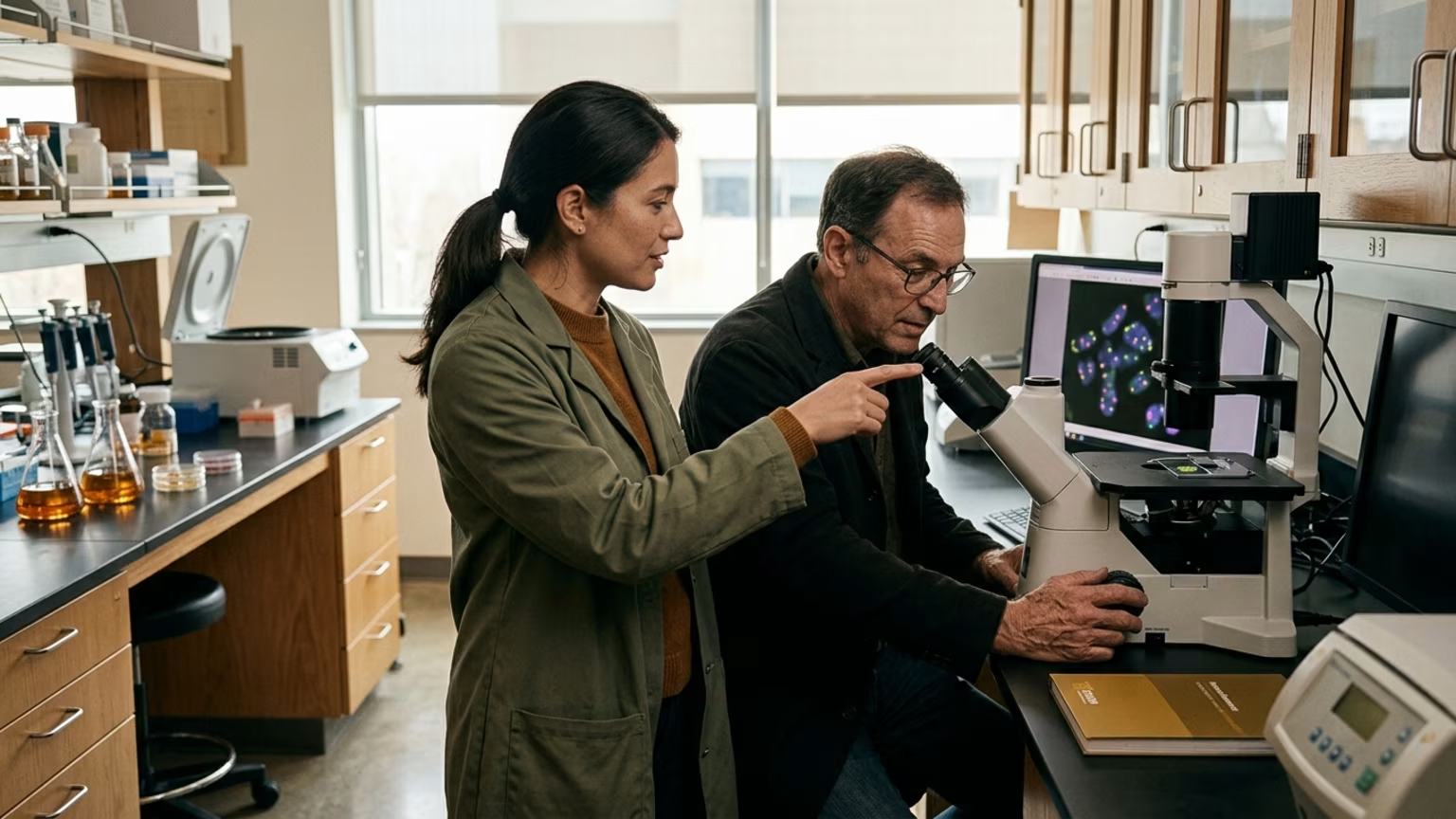

A 2025 in-vitro study on the epitalon peptide highlights varying telomere-maintenance mechanisms in human cell lines without proving human lifespan extension.





In September 2025, Al-Dulaimi and colleagues published a study in Biogerontology examining the peptide epitalon. The research gained renewed attention through a paid press release distributed by ACCESS Newswire on Yahoo Finance in September 2026.
The primary conclusion of the in-vitro research centers on cellular maintenance mechanisms rather than demonstrated lifespan extension. The study observed dose-dependent increases in telomere length across different types of human cell lines. However, researchers noted that these localized cellular changes do not establish that the compound reverses biological aging. The observations simply outline how specific isolated cellular pathways respond to chemical stimuli.
This study was conducted in vitro using cultured human cell lines, not in animal models or human subjects.
The initial study by Al-Dulaimi and colleagues was published in September 2025. However, the findings experienced a sudden resurgence in public visibility a full year later. A news item discussing the research appeared on Yahoo Finance on September 29, 2026, and was updated on September 30. This delayed timeline is a common feature when analyzing longevity research news.
Research published in specialized academic journals often takes time to reach mainstream financial platforms. In this instance, the renewed attention did not come from a newly completed clinical trial. Instead, the visibility stemmed directly from a paid press release distributed through a commercial network.
Understanding the origin of scientific news is critical for accurate interpretation. The Yahoo Finance page explicitly labels the item as a paid press release. It was distributed by ACCESS Newswire, which functions as a commercial distribution network. This means the article represents promotional coverage of the research rather than independent journalism.
Furthermore, the press release does not offer an independent assessment of the study's scientific quality. It simply amplifies the laboratory findings for a broader commercial audience. Readers must treat the release as a summarized notification rather than a comprehensive scientific review.
The subject of the research is a compound commonly known as epitalon. It is also frequently referred to as Epithalon in scientific and commercial literature. The Yahoo article describes epitalon as a synthetic four-amino-acid peptide. Its specific chemical composition consists of the sequence Ala-Glu-Asp-Gly, which is commonly abbreviated as AEDG.
Synthetic peptides like AEDG are designed to interact with biological pathways in a controlled manner. Because it is a small chain, it is relatively easy to study in isolated laboratory environments. Reviewing the mechanisms of peptides and emerging therapies requires distinguishing between these localized reactions and systemic benefits.
The 2025 Biogerontology paper, identifiable by the DOI 10.1007/s10522-025-10315-x, focused on specific cellular measurements. The researchers examined the peptide's effects across a variety of cultured human cell lines. Their laboratory models included normal epithelial cells and normal fibroblasts. To provide a comprehensive view, the study also included tests on breast cancer cell lines.
During these controlled experiments, the research team measured several distinct biological markers. They specifically tracked overall telomere length and monitored hTERT expression. Additionally, they measured standard telomerase activity and tracked the alternative lengthening of telomeres.
The study's results demonstrated that the peptide's mechanism of action changes depending on the cellular environment. In the normal epithelial cells and fibroblasts, the article reports dose-dependent telomere-length increases. These specific increases in the normal cells were directly associated with increased hTERT expression. The heightened hTERT expression was subsequently linked to increased telomerase activity.
Telomerase is the primary enzyme responsible for maintaining telomere length in healthy dividing cells. This data provides mechanistic insight into how the AEDG peptide influences standard maintenance pathways. Understanding these pathways is a fundamental part of biology of aging and longevity science.
However, the biological response shifted significantly when researchers observed the breast cancer cell lines. The study also reported telomere-length increases within these specific cancer models. Crucially, the mechanism driving this cellular change was entirely different.
The telomere-length increases in the cancer cell lines were associated with the alternative lengthening of telomeres. The alternative lengthening of telomeres, or ALT, operates independently of standard telomerase activity. This distinction proves that the synthetic peptide does not rely on a single biological pathway.
While the Yahoo article describes the telomere changes as dose-dependent, it omits critical quantitative information. The press release does not provide the numerical doses used during the experiments. It fails to mention the specific chemical concentrations applied to the cultured cells. Furthermore, the coverage lacks any details regarding the exact treatment durations.
It also omits the specific dose-response values recorded by the researchers. Without these precise numerical details, readers cannot infer the actual potency of the peptide. It is impossible to evaluate the practical relevance of the findings based solely on the press release.
The available evidence contains multiple weaknesses that prevent broad clinical application. Evaluating these limitations is essential for anyone following early-stage biological research. The primary weaknesses of the study and its coverage include:
The final limitation regarding the journal correction requires careful consideration. A secondary evidence summary reports that the paper's journal record is accompanied by a formal correction. According to a source identifying the issue, incorrect versions of Figures 1, 2 and 3 appeared in the original publication.
The journal subsequently supplied corrected versions of these specific figures. While another secondary summary notes that the correction did not retract the paper, caution is still necessary. Readers should independently verify the correction notice before drawing conclusions about the study's overall reliability.
A critical error in evaluating longevity research involves conflating laboratory cell lines with human biology. "Human cell lines" refers exclusively to human-origin cells cultivated in isolated laboratory containers. It does not imply that the compound was administered to living people. The Yahoo coverage explicitly says the cell experiments do not establish human effects.
The article clearly states that the experiments do not demonstrate that epitalon extends human lifespan. Furthermore, it confirms that the laboratory data does not prove the compound reverses biological aging. The biological reality of aging involves multiple interconnected systemic processes. Telomere length is only one isolated component of a vastly complex biological framework.
Changing a single cellular variable in a glass dish rarely translates seamlessly into whole-body benefits. A PREreview preprint summary supports this cautious approach regarding the AEDG peptide. The summary explicitly states that human pharmacokinetic and dedicated prospective safety studies remain entirely unavailable. Consequently, any claims regarding human efficacy or safety are fundamentally unsupported by the cited research.
Treating this in-vitro research as a completed medical intervention is premature and scientifically ungrounded. The findings should be viewed strictly as a mechanistic research lead concerning isolated telomere-maintenance pathways. When discussing the paper, it is crucial to distinguish the normal-cell findings from the cancer-cell ALT findings. The distinct pathways must be named accurately rather than collapsed into a generic claim about telomerase activation.
A careful reader will not extrapolate a personal dose or an expected safety profile from these isolated cultured cells. Following rigorous longevity science and healthy aging resources requires patience and a commitment to verifiable evidence. Independent replication and dedicated human studies measuring clinically meaningful outcomes are required to determine whether these laboratory findings translate into genuine biological benefits.
Assuming isolated laboratory cell responses will guarantee whole-body human results is a common trap when evaluating new synthetic peptide research. AgeAmaze helps readers navigate the difficulty distinguishing animal research from human evidence, ensuring you clearly understand the true clinical limits of early mechanistic studies before making health decisions. Read the research
Stay current with research on aging biology, biomarkers, nutrition, therapeutics, peptides and longevity technology. AgeAmaze reports what the evidence shows, where uncertainty remains and which claims still need stronger data.





Follow AgeAmaze for careful reporting on what longevity science can show today and what still needs stronger evidence.
read the Blog