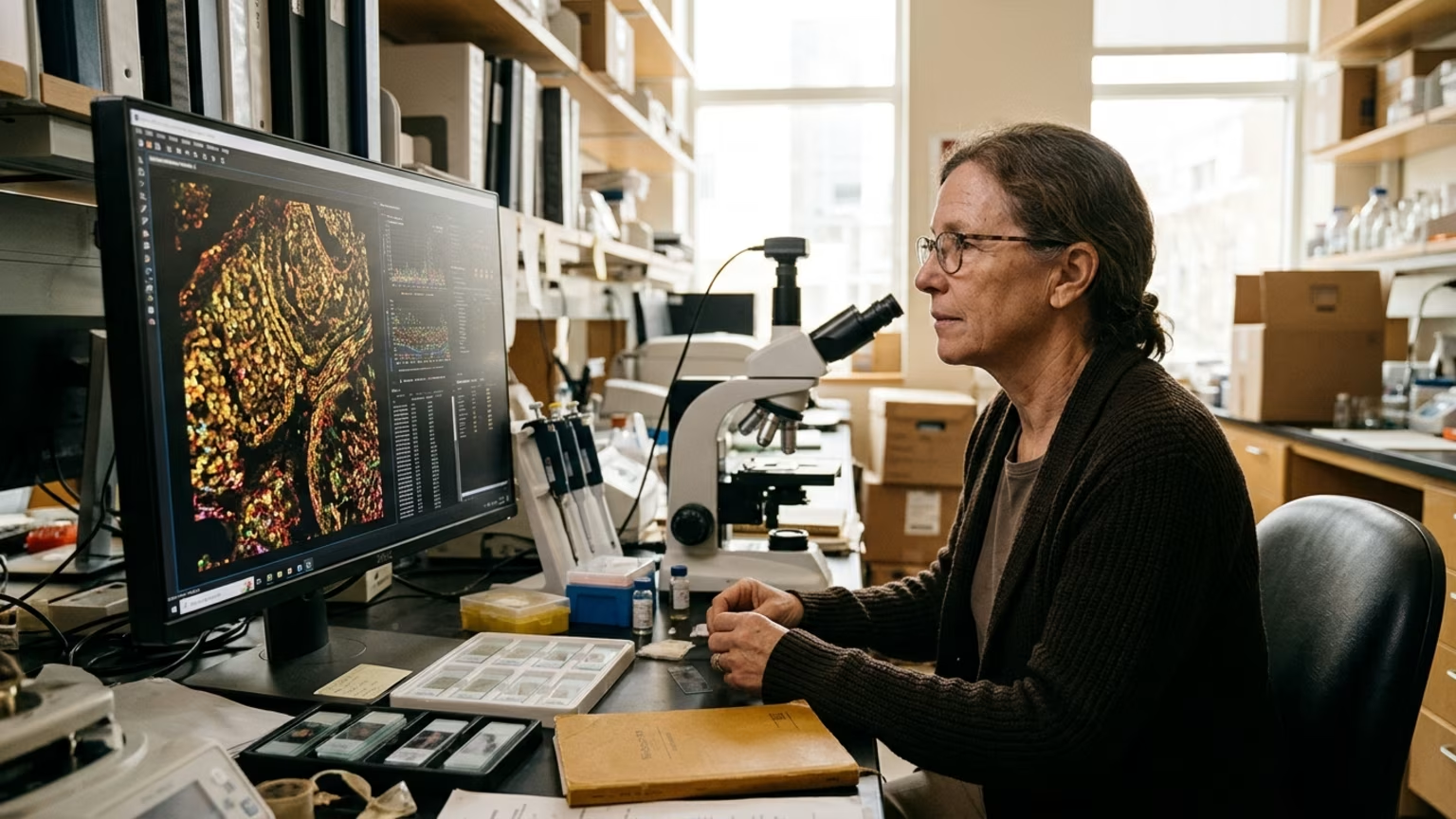

Spatial proteomics preserves tissue context in aging research. Human osteoarthritis findings show the promise and the validation steps still ahead.





On November 3, 2026, Technology Networks published an interview with Birgit Schilling of the Buck Institute for Research on Aging about spatial proteomics research involving human knee osteoarthritis. The interview took place at the 2026 Human Proteome Organization (HUPO) World Congress in Singapore, which ran from September 27 to October 1, 2026.
The central observation Schilling described was that localized changes in affected bone could be obscured by a global analysis of tissue proteins. Spatial proteomics preserves information about where molecular signals occur, helping researchers connect a protein pattern with a particular tissue region. GEN's conference coverage independently described the work as revealing changes that bulk analysis could obscure. For healthy aging research, the importance lies in identifying tissue-specific signals that investigators could then follow into fluid samples as potential biomarkers.
Evidence model: Human tissue research. The knee osteoarthritis work involved human samples, and the separate aging preprint discussed below also studied humans.
Schilling is a professor at the Buck Institute for Research on Aging and directs its Mass Spectrometry and Proteomics Technology Center. She told Technology Networks that her laboratory had acquired a timsTOF fleX mass spectrometer in the preceding 12 months. The instrument enabled spatial proteomics alongside spatial lipidomics and metabolomics. She also described using it for spatial glycomics.
The useful distinction is between preserving location and measuring proteins across a sample. In the osteoarthritis example, Schilling's team examined localized changes in human knee bone. Her account illustrates why the location of a signal can be part of the biological finding rather than merely a detail added to a protein list.
Schilling described spatial and global or deep proteomics as complementary approaches. The spatial work identifies a tissue region of interest. A deeper fluid analysis then asks a related question about proteins in a different sample. In this research direction, the tissue map helps determine what investigators should look for next.
For the knee work, that next sample is synovial fluid. Schilling described following tissue findings into this fluid using deep proteomics based on liquid chromatography and mass spectrometry. GEN likewise reported that the team was pursuing synovial-fluid biomarker work. The proposed sequence connects a localized tissue observation with a search for a measurable fluid signal.
For readers comparing aging measurements, the practical habit is to keep track of which biological sample a result represents. A tissue location and a fluid protein profile answer related questions, but the study needs to establish the connection between them.
A separate bioRxiv preprint posted in October 2026 examined the relationship between circulating proteins and tissue proteins in human aging. It profiled 5,415 proteins in 178 adults aged 20 to 87. The study included matched plasma and muscle samples from 56 people. It also included matched plasma and ovary samples from 24 people.
These matched samples gave the authors a way to compare protein measurements in plasma with measurements in the corresponding tissue. They reported that 50 muscle proteins and 17 ovarian proteins were significantly correlated with their plasma counterparts. The authors characterized plasma as a selective and context-dependent view of tissue aging rather than a complete readout of tissue protein abundance.
The preprint also reported differences in age-associated proteins and pathways across tissue and sex groupings. Its relevance to spatial proteomics is conceptual: it provides another reason to ask which tissue a circulating signal represents. It is a separate project from Schilling's osteoarthritis work and does not serve as validation of her laboratory's findings.
Read together, the projects highlight distinct research questions. Spatial measurements ask where a signal occurs within tissue. Matched plasma and tissue measurements ask how closely a circulating signal corresponds to a tissue measurement. The fluid-biomarker direction described by Schilling sits between those questions by seeking a connection from a localized finding to a fluid sample.
That distinction also helps keep biomarker interpretation focused. A protein may be interesting because of its location or its association with age. Establishing its relationship to a meaningful health outcome is a further research question. This is the broader challenge of connecting molecular measurements with real-world health.
The tissue-focused work does not require abandoning circulating proteins as a research approach. A separate Nature Aging study published on November 2, 2026 examined age-associated proteins in low-volume mouse serum and compared them with human plasma data. The researchers reported that some proteins, including COL6A3, were linked to frailty in humans.
That study used a different evidence model: mouse serum profiling alongside human plasma comparisons. Its contribution belongs to circulating-protein research rather than the human knee tissue project. Together, these examples support a complementary approach to biomarker research in which investigators examine tissue location and fluid measurements without treating them as interchangeable.
The next logical phase is to test whether the tissue-linked candidates can be measured reliably in fluid and validated against clinically meaningful outcomes.
A detailed protein map becomes misleading when its visual precision is taken as evidence that a personal aging test is ready for use. AgeAmaze explains biomarker research by distinguishing experimental observations from established health findings, giving research-minded adults context for assessing emerging longevity science without turning preliminary results into promises.
Stay current with research on aging biology, biomarkers, nutrition, therapeutics, peptides and longevity technology. AgeAmaze reports what the evidence shows, where uncertainty remains and which claims still need stronger data.



Follow AgeAmaze for careful reporting on what longevity science can show today and what still needs stronger evidence.
read the Blog

