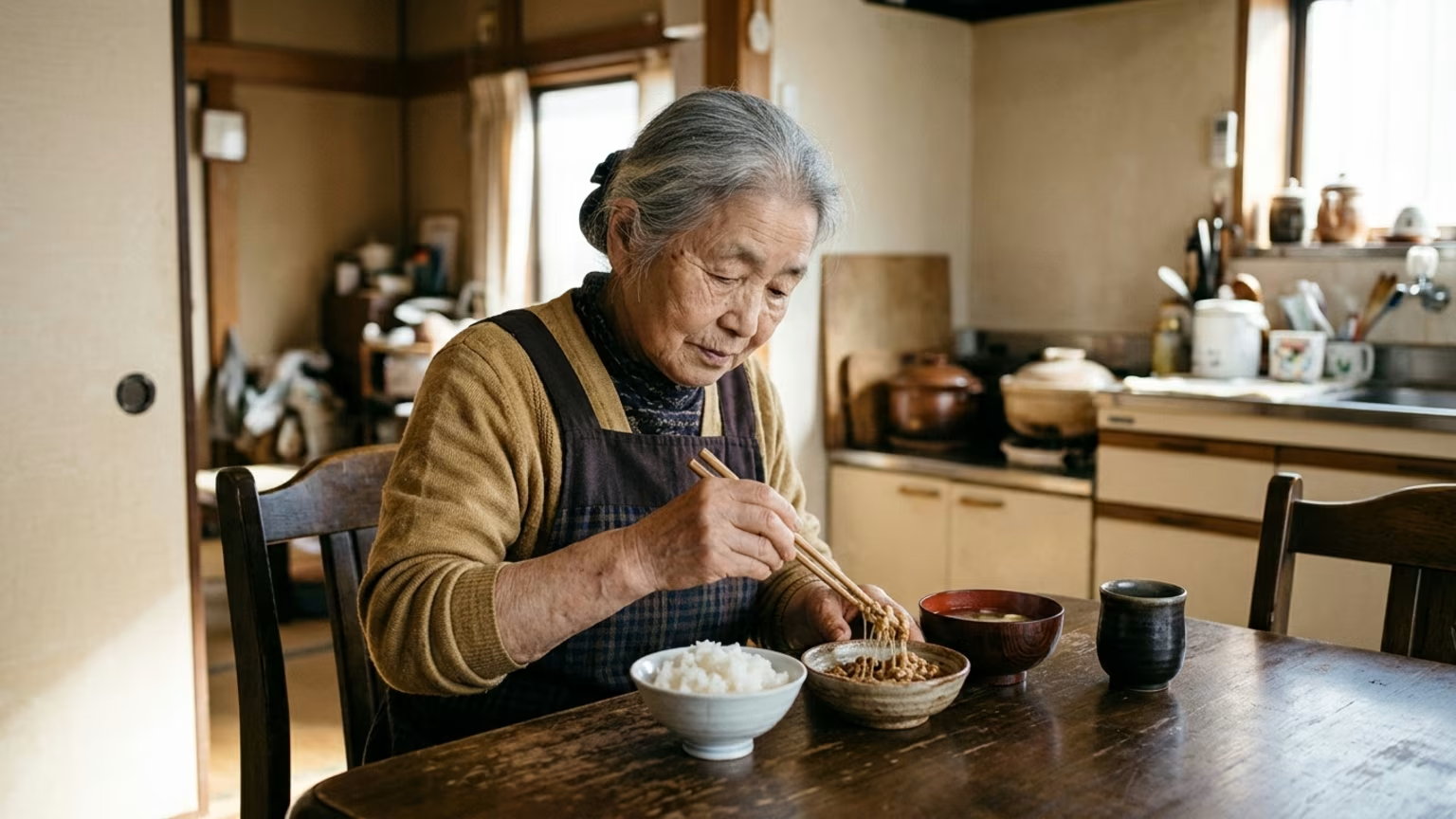

A closer look at natto’s reported mortality associations and bone markers, with the limits of observational evidence kept clear.





A late-2025 meta-analysis of six studies associated habitual natto consumption with improved vitamin K status and bone-metabolism markers, according to New Atlas’s report dated 2026-10-21. The study’s lead institution is not identified in that account.
The central signal is that natto consumption tracks with selected health outcomes in Japanese observational research. New Atlas describes associations with cardiovascular mortality, an all-cause mortality finding in older men and bone-related measures in a separate synthesis. A broader fermented-soy finding also contributes to the discussion. Together, these findings provide reasons to investigate natto further as a possible contributor to healthy aging rather than establish it as a longevity intervention.
Evidence type: Humans, with mortality findings from observational studies and bone findings described as largely observational.
This is not a case of an animal lifespan experiment being presented as a human dietary finding. The reported research concerns people and their health outcomes. Understanding it requires keeping the food being studied, the population being followed and the outcome being measured attached to each result.
New Atlas reports that a 2020 study of 92,915 adults associated higher fermented-soy consumption with lower all-cause mortality. Natto intake was separately associated with lower cardiovascular mortality. The all-cause finding belongs to the broader fermented-soy category, not to natto alone. An accurate reading therefore preserves both the dietary category and the distinction between deaths from any cause and cardiovascular deaths.
The report also describes the 2017 Takayama study, which included nearly 30,000 participants. Researchers reported lower cardiovascular mortality among those with the highest natto intake than among those with the lowest intake, after adjustment for other factors. Here the comparison was specifically about natto consumption. Its cardiovascular outcome should remain separate from the broader mortality finding in the fermented-soy study.
A further finding came from a 15-year observational study of 1,548 older Japanese men described in a 2025 report. According to New Atlas, regular natto consumers had a 40% lower all-cause mortality estimate than men who never consumed it. This is the most striking reported figure in the account. Its proper label is a comparison between consumption groups within that particular study.
These studies contribute different pieces to the evidence. One concerns a fermented-food category and several concern natto specifically. Some examine cardiovascular deaths while another examines deaths from any cause. Keeping those distinctions visible makes the overall pattern easier to assess without turning separate findings into a single claim.
According to New Atlas, the late-2025 meta-analysis assessed six studies involving Japanese populations. Its reported outcomes included serum MK-7, osteocalcin carboxylation and bone mineral density. The reported conclusion connected habitual natto consumption with improved vitamin K status and bone-metabolism markers. These are the specific findings behind the bone-health discussion.
This strand of research asks a different question from the mortality studies. It concerns measurements related to vitamin K and bone health rather than deaths during follow-up. Reading the studies together is useful for identifying research priorities. Their results still need to retain their original outcome labels rather than merge into a general statement about longer life.
New Atlas describes natto as cooked soybeans fermented with Bacillus subtilis var. natto. It is a concentrated dietary source of vitamin K2, especially MK-7. The report lists a 50-gram serving as providing 8.3 grams of protein and 4.8 grams of fiber. It also reports 50 milligrams of magnesium and 330 milligrams of potassium for that serving.
Those details describe the food’s composition. They provide nutritional context for the studies without changing the kind of evidence those studies collected.
For research-minded readers, the clearest approach is to keep three questions together: what was consumed, who was studied and what outcome changed. Those questions preserve the useful information in the findings without overstating their reach. Decisions about personal dietary changes or supplements belong in an individualized discussion with a qualified healthcare professional rather than being based on a headline mortality estimate.
The next logical phase is well-designed human intervention research that tests natto consumption against clearly defined clinical outcomes, alongside replication of the reported associations in more diverse populations.
After reviewing natto’s reported associations, the next task is judging any longevity claim built on them, and AgeAmaze supplies readable scientific context for that judgment. Its research-led coverage distinguishes experiments in animals from studies involving people, helping readers understand where a dietary finding sits without converting preliminary evidence into a health promise.
Stay current with research on aging biology, biomarkers, nutrition, therapeutics, peptides and longevity technology. AgeAmaze reports what the evidence shows, where uncertainty remains and which claims still need stronger data.





Follow AgeAmaze for careful reporting on what longevity science can show today and what still needs stronger evidence.
read the Blog

