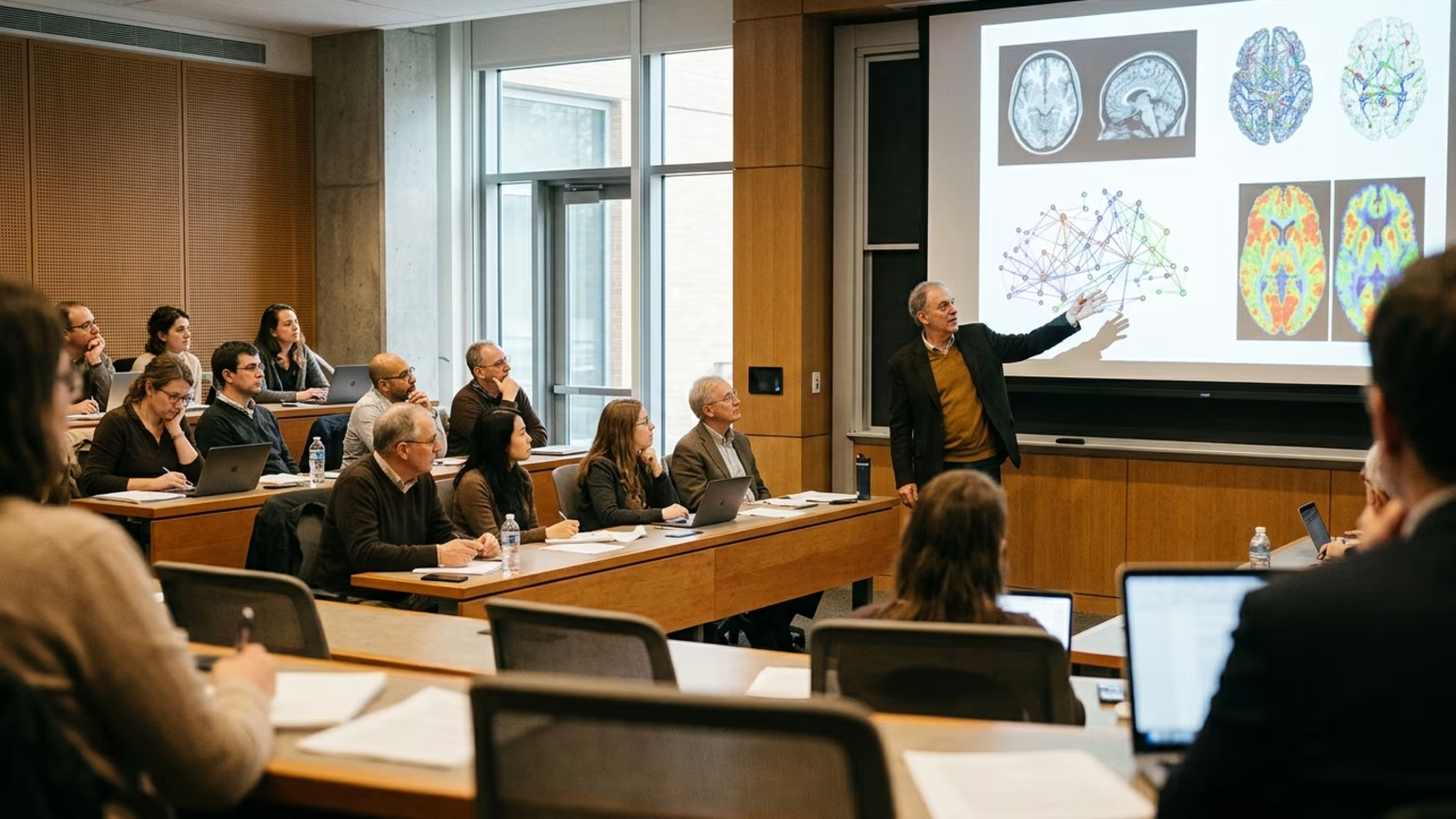

MIT's aging-brain symposium featured AI, MRI probes and cell models. Learn what the projects aim to measure and which validation questions remain.





MIT's Aging Brain Initiative held its “Innovations for the Aging Brain” symposium on September 25, 2026. In a recap published on September 30, the Picower Institute at MIT described six talks on research intended to improve understanding of aging-related brain health and potential interventions.
The central message of MIT's account is that researchers are pursuing complementary ways to study brain aging through better measurements and models. The intended healthspan relevance is improved understanding of brain health alongside future advances in diagnosis and treatment evaluation. Brain-wave measurements and molecular MRI probes sit alongside AI systems and laboratory disease models in this agenda. Together, these projects describe a research direction focused on connecting biological information with questions about brain health rather than a single intervention aimed at extending life.
Research setting: The symposium included in vitro patient-derived cell models and projects drawing on human clinical-trial data; it was a mixed research program rather than a single animal or human experiment.
According to MIT's recap, the presentations covered neuroscience and engineering alongside chemistry and molecular biology. The disease scope included Alzheimer's disease and Parkinson's disease as well as ALS and muscular dystrophies. Cognitive effects associated with anesthesia were also part of the program.
These projects belong to different research categories. A laboratory model serves a different purpose from a measurement taken during anesthesia or an AI system combining existing information. The useful reading task is to identify what each project is designed to contribute before grouping everything under the broad label of brain-aging technology.
MIT described FINGERS-7B as an AI system under development to combine clinical-trial data with lifestyle histories and multi-omics information. The latter includes genomics and proteomics. The proposed role is to help tailor interventions and inform future trial design.
Project lead Adrián Noriega de la Colina explained the motivation: “Every individual is very unique in their biology and that links to how we respond to those interventions.” His comment places individual biological differences at the center of the project's research aims.
The important distinction is between the information a system brings together and the question it is intended to answer. Combining trial information with lifestyle histories is a development strategy. Whether that combination can support a particular prevention decision is a separate evaluation task.
For readers, the project is best understood as an attempt to organize several kinds of evidence around personalized Alzheimer's prevention. That framing keeps attention on its intended purpose rather than treating the presence of AI as the main scientific result.
MIT's recap described brain-wave measurements intended to inform anesthesia dosing. This places the measurement approach in a specific clinical context: understanding brain activity in relation to anesthesia. The symposium also addressed cognitive effects associated with anesthesia.
That context should remain attached to the project when discussing its relevance to aging. A presentation about anesthesia-related brain signals should be read first as research addressing that setting. It should not be casually relabeled as a general brain-age assessment.
A useful question for subsequent reports is therefore precise: what decision is the signal intended to inform? Readers can then assess evidence against that purpose rather than against the much broader promise of measuring overall brain health. The symposium's scope shows why the term “brain biomarker” needs a clearly stated job.
Another presentation concerned chemical probes for visualizing brain molecules and activity with MRI, according to MIT. This is a measurement project with a molecular focus. Its stated purpose differs from simply combining existing records in an AI system.
The editorial distinction matters because the word “measurement” can conceal different research questions. Here, the question concerns what a probe can make visible. For the AI project, the question concerns how different information sources might be brought together.
When reading future coverage, the first task is to identify the proposed readout. Is the report discussing a molecule or an activity-related signal? What research question is that signal meant to address?
AgeAmaze's discussion of different ways to assess aging-related signals provides a related reading path. The emphasis should remain on the purpose of a measurement rather than assuming that all brain-health indicators are interchangeable.
MIT also presented patient-derived cell models of ALS. These belong to the laboratory-modeling side of the program. Their inclusion reflects the symposium's interest in modeling disease biology as well as measuring brain-related signals.
The patient origin of a cell model and the setting in which it is studied are separate descriptions. Keeping both visible helps readers classify the evidence accurately. The work is about a patient-derived laboratory model rather than a measurement taken directly from that patient during a clinical assessment.
This distinction is especially useful when several projects appear in the same institutional recap. Sharing a symposium does not give every presentation the same evidentiary role. Readers interested in that separation can consult AgeAmaze's guide to interpreting the path from laboratory research to human healthspan evidence.
The recap also described methods to study protein misfolding and research on cell-surface glycans. These presentations added molecular research to a program that already included imaging and AI. MIT's account places them within the broader effort to understand aging-related brain health.
Their contribution should be described at the level reported: research methods and biological subjects under investigation. The relevant question is what each approach helps researchers study. That is a different question from whether a measurement should guide an individual's care.
ABI director Li-Huei Tsai described the initiative as bringing together researchers from diverse fields. The range of presentations gives that description concrete meaning. Engineering-based measurement projects appeared alongside cell models and molecular work rather than being presented as one uniform technology.
A separate paper titled Clinically altered brain activity may not look like aged brain activity makes this distinction explicit in its framing. Its title offers a useful question to bring to the symposium: is a proposed signal intended to describe aging or to identify a clinical alteration?
For this event, that question helps organize the different ambitions described by MIT. Understanding biological processes is one aim. Improving diagnosis and measuring treatment efficacy are other aims. A clear account should state which aim applies to a particular project before discussing its potential value.
The symposium provides a view of research priorities. Its evidentiary boundaries are important:
The practical response is to classify the claim before assessing its promise. Start with what the proposed measure is intended to capture. Then look for how it was tested and whether the evaluation involved people. Finally, check whether an independent evaluation supports the intended use.
It is also useful to separate biological research from outcome tracking and individual clinical decisions. A tool proposed for one of those purposes should be assessed against that purpose. This keeps the evaluation specific without dismissing early work simply because it addresses an earlier research stage.
For personal questions about cognition or diagnosis, qualified clinical care is the appropriate setting. The symposium is a guide to research directions rather than a basis for selecting an individual test or intervention.
The next phase should pair each proposed measurement with a clearly defined use and then test its performance in people through transparent studies and independent validation.
More informative brain-health measurements are the goal connecting these projects; AgeAmaze makes the underlying longevity research easier to understand without presenting early aims as established benefits. Its explanations help skeptical readers keep animal experiments separate from evidence in people while understanding where emerging biomarkers fit within healthy-aging research.
Stay current with research on aging biology, biomarkers, nutrition, therapeutics, peptides and longevity technology. AgeAmaze reports what the evidence shows, where uncertainty remains and which claims still need stronger data.



Follow AgeAmaze for careful reporting on what longevity science can show today and what still needs stronger evidence.
read the Blog

