
A recent human study reveals that cellular recycling rates vary by sex and tissue type, complicating the belief that autophagy simply declines as we age.





On September 27, 2026, researchers at Sanford Burnham Prebys published a peer-reviewed study in the journal Aging Cell examining how cellular recycling patterns change during human aging.
The primary conclusion complicates the assumption that cellular recycling strictly slows down as humans age. The research showed that autophagy activity differs significantly based on biological sex and the specific tissue being measured. In adults aged 70 and older, higher recycling activity was linked to poorer physical function. This suggests that increased cellular recycling in late life might represent a biological stress response rather than a marker of healthy aging.
This study was conducted in humans using skin-derived fibroblasts, induced neurons, peripheral blood immune cells and a small exercise pilot.
Autophagy is the critical biological pathway that cells use to break down and recycle damaged internal components. Researchers measure the activity of this pathway through autophagy flux. Flux represents the actual functional rate of the cellular recycling process. The study highlights that measuring the expression of autophagy genes does not reliably mirror this active physical rate.
Many researchers use static markers or transcription levels to estimate cellular health. Lead author Tatiana Moreno warned that scientists using these static measures need to be careful in their interpretations. Gene expression results alone may fail to show how actively the recycling process is running. The researchers found that static measures of specific cellular structures did not reliably correlate with flux in the examined cells. Understanding the true rate of these mechanisms is a core focus in cellular health and metabolism.
Understanding this study requires looking closely at how cellular recycling operates within human biology. Autophagy literally translates to self-eating, acting as the internal waste management system for human cells. The process identifies damaged proteins, degraded cellular structures and poorly functioning mitochondria. It then packages these damaged components and breaks them down into usable building blocks.
This process is incredibly dynamic and constantly adjusts to environmental stressors. When a cell experiences nutrient deprivation, the recycling system typically accelerates to provide necessary fuel. However, researchers have struggled to measure this dynamic process accurately in living human patients. The Sanford Burnham Prebys team specifically focused on flux to capture this real-time functional activity.
Previous studies often relied on analyzing RNA sequencing to estimate recycling capacity. The assumption was that higher expression of relevant genes equaled a faster recycling rate. This new data proves that transcription levels are an inadequate proxy for actual physical function. Researchers must utilize sophisticated assays to observe the real rate of biological clearance.
The researchers analyzed gene-expression data and measured autophagy flux across three distinct human cell types. They tested skin-derived fibroblasts, induced neurons created from skin cells and freshly isolated peripheral blood mononuclear cells. Peripheral blood mononuclear cells are a specific group of blood immune cells. The study included 44 fibroblast samples, 22 induced-neuron samples and 23 immune cell samples.
The age range for these specific flux measurements spanned from 23 to 80 years old. The researchers found that age patterns differed significantly depending on the cell type and the biological sex of the participant. For example, autophagy flux steadily declined with age in male fibroblasts. However, the exact same recycling process remained stable in female fibroblasts over time.
The results were entirely different in induced neurons. In female induced neurons, cellular recycling activity actually increased as the cells aged. Meanwhile, the immune cell samples showed that flux became more variable with age. While the immune cells trended toward higher activity in older participants, this overall association did not reach statistical significance.
These stark differences challenge sweeping narratives about human aging. Senior author Caroline Kumsta noted that evidence for the common claim that autophagy declines with age in humans is very thin. The data argues for evaluating cell type, sex and age together. Assuming a single whole-body direction of change ignores the complex reality of human biology. This targeted approach reflects a growing standard within the biology of aging and longevity science.
The study also examined how these cellular recycling rates relate to observable physical function in older adults. Researchers focused specifically on participants aged 70 and older. Among this older demographic, higher autophagy flux was associated with poorer physical performance. The specific negative associations varied based on the exact cell type being tested.
High recycling activity in peripheral blood immune cells was linked to lower aerobic capacity and slower walking speeds. Conversely, high activity in induced neurons was associated with lower grip strength. These associations suggest a counterintuitive relationship between cellular recycling and physical capability in late life. High flux should not automatically be interpreted as a beneficial state.
Kumsta cautioned against treating increased autophagy flux as uniformly beneficial across all age groups. She stated that higher cellular recycling may be good in younger people yet problematic in older people. The researchers concluded that elevated flux in older adults might reflect a compensatory response. The cells could be ramping up recycling to handle age-related stress rather than displaying greater functional capacity. Interpreting these signals correctly is vital when evaluating age biomarkers and diagnostics.
The specific physical assessments used in the study provide valuable insight into late-life aging. Researchers measured aerobic capacity, baseline walking speed and overall grip strength in the older cohort. These metrics are standard clinical markers used to evaluate physical frailty in aging populations. Declines in these specific areas often predict broader health complications in older adults.
The correlation between high immune cell flux and slower walking speeds is particularly notable. Immune cells are constantly exposed to systemic signals circulating throughout the bloodstream. If the body is experiencing chronic inflammation, these immune cells might upregulate their internal recycling. Therefore, the elevated flux acts as a biomarker of systemic distress rather than youthful vitality.
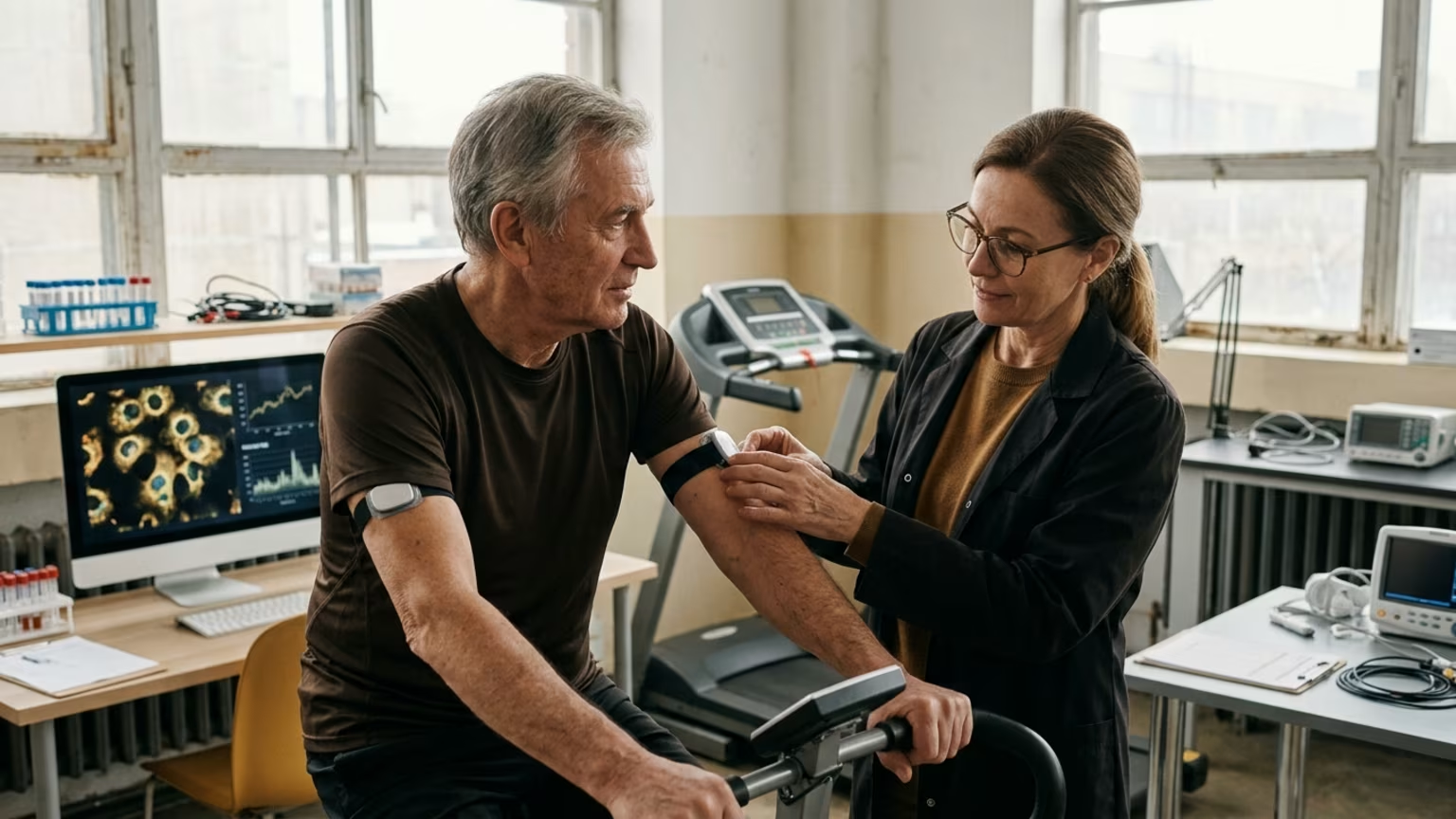
To observe how lifestyle interventions might influence these cellular metrics, the researchers conducted a pilot exercise program. The trial included five older adults between the ages of 77 and 88. These participants completed a 12-week mild, digitally delivered fall-prevention program. The intervention involved weekly one-hour sessions heavily focused on balance, strength and posture.
Following the 12-week period, the researchers measured changes in the participants' physical function and cellular recycling rates. Peripheral blood immune cell flux decreased in four of the five participants. Alongside this reduction in cellular recycling, the participants demonstrated improved physical-function scores. The paper clearly describes these early findings as preliminary observations.
The digitally delivered fall-prevention program was intentionally designed to be mild and accessible. Participants engaged in weekly sessions that prioritized fundamental movement mechanics over intense cardiovascular exertion. The focus on balance and posture addresses the primary physical vulnerabilities faced by adults in their eighties. This gentle approach ensures that the intervention is safe for highly advanced age groups.
Despite the low intensity of the exercise, the cellular responses were measurable and consistent. A reduction in immune cell recycling occurred alongside tangible improvements in physical stability. This suggests that even mild movement can potentially alleviate the systemic stress driving elevated cellular recycling. The cells may require less active maintenance when physical function begins to stabilize.
These results mirror the study's earlier associative data regarding older adults. If high flux in late life signals cellular stress, a physical intervention that reduces stress might naturally lower that flux. However, the pilot cannot establish that lowering immune cell autophagy directly caused the physical improvements. The study simply measured parallel changes occurring within a very small group. Translating these small pilots into proven longevity interventions and therapeutics requires careful validation.
The Sanford Burnham Prebys study addresses a prominent, ongoing issue in modern longevity research. Scientists must determine how to accurately interpret autophagy measurements in living humans. Activity clearly differs across various tissues and organs. Furthermore, this activity cannot be reliably inferred from simple gene-expression data alone.
For individuals reading this research, the key takeaway is heavily context-dependent. The concept that more autophagy is a universal longevity target is not supported by these findings. Interpretation depends entirely on a person's age, the specific cell type measured and the assay utilized. The study does not establish an exercise prescription for manipulating cellular recycling.
The assumption that rapid cellular recycling equates to biological youthfulness is widespread in health optimization circles. However, the Sanford Burnham Prebys team has demonstrated that this metabolic pathway serves fundamentally different purposes across different stages of human life. Pushing an older adult's cells to recycle materials faster might artificially induce the very stress signals the body is trying to manage. Medical professionals must carefully consider these nuanced biological realities before recommending lifestyle changes aimed at altering metabolic pathways.
Additionally, the current data does not show that testing your own autophagy rate can predict your individual healthspan. The relationship between physical function and cellular recycling is highly complex. Future clinical applications will require a much deeper understanding of these tissue-specific differences. Until then, broad claims about resetting or maximizing autophagy in humans warrant heavy skepticism.
The scientific community is moving away from simplistic models of human aging. Assuming that all biological processes universally degrade at a steady rate is no longer viable. This study highlights the absolute necessity of precise, localized measurement techniques. Researchers must evaluate specific tissues to understand localized cellular environments accurately.
When older adults experience physical decline, their cellular responses may be protective adaptations. Ramping up recycling processes could be the body's method of managing accumulated damage. If science blindly attempts to increase these processes further, it could potentially disrupt delicate compensatory mechanisms. This highlights the danger of translating basic biological theories into premature human treatments. Staying updated on this rigorous methodology is the focus of our longevity research and news coverage.
This research contains several important limitations:
According to the institute's announcement, larger exercise studies with more participants and improved testing protocols are currently underway to validate these findings.
Accurately interpreting how tissue-specific cellular recycling rates impact physical function requires a rigorous analysis of the underlying clinical data. AgeAmaze clarifies this persistent confusion over conflicting longevity studies, ensuring our readers can evaluate complex cellular processes without mistakenly assuming that increased autophagy is always medically beneficial. Read the research
Stay current with research on aging biology, biomarkers, nutrition, therapeutics, peptides and longevity technology. AgeAmaze reports what the evidence shows, where uncertainty remains and which claims still need stronger data.





Follow AgeAmaze for careful reporting on what longevity science can show today and what still needs stronger evidence.
read the Blog

